Published on · By Ricard Prehn, professional recreational skipper (PPER), Spanish Yacht Captain (capitán de yate), Yacht Captain up to 200 GT, GMDSS General Operator and sailing instructor for over 27 years
Yes, if you are colour-blind you can get the PER, the PNB or the Navigation Licence. The course and exam are the same for everyone. The only change is on the medical certificate: if you cannot tell red from green reliably, the law provides that you sail by day only, or at night not alone.
The reason is simple: at night at sea, buoys and vessels are read by the colour of their lights. By day, on the other hand, buoyage marks have different shapes precisely so that you do not depend on colour alone.
Can a colour-blind person get the PER or the PNB?
Yes. Colour blindness does not stop you taking the course, passing the exam or getting the licence. What can change is the medical certificate: if your colour vision prevents you from reading lights at sea correctly, the licence lets you sail by day without limits and at night only if you are not alone on board.
I get asked this more than you might think, usually by people afraid of paying for the course and ending up without a licence. That is not the case: colour blindness affects when you can sail on your own, not whether you can hold the licence. And most leisure sailing, especially at the start, is done by day.
What exactly does the law say about colour blindness?
Royal Decree 875/2014, Annex VIII (section 1.4, "light sense and colour vision"), does not accept colour blindness or other colour-vision defects that prevent correct interpretation of light signals, and the restriction it sets out is daytime-only sailing or night sailing not alone.
In other words: the medical centre checks whether you can tell colours apart. If you cannot tell them apart well enough to read lights, it does not refuse the certificate, it adds a condition. You can read it yourself in the consolidated text of Royal Decree 875/2014 in the Spanish Official Gazette (Annex VIII, section 1).
If I have a recent driving licence, do I skip the colour test?
No. With a driving licence obtained or renewed less than two years ago you do not need a full new medical, but the law still requires a colour-vision check, especially green and red, at a drivers’ medical centre (art. 22.7 and 22.8 of RD 875/2014).
In other words, the law takes red and green so seriously that it is the one thing they check again even if you skip the rest. Where to get it, what it costs and when to get it is in our article on the maritime medical certificate; note that it expires after 90 days.
Why buoys are shaped like cylinders and cones
In Spain (IALA region A), when entering harbour you leave the red, cylindrical marks to port and the green, conical ones to starboard. On charts and diagrams they are drawn as a rectangle and a triangle. It is not decoration: the shape is there so you can identify the mark even if you cannot see its colour, whether because it is against the light, because the gulls have turned it white or because you are colour-blind.
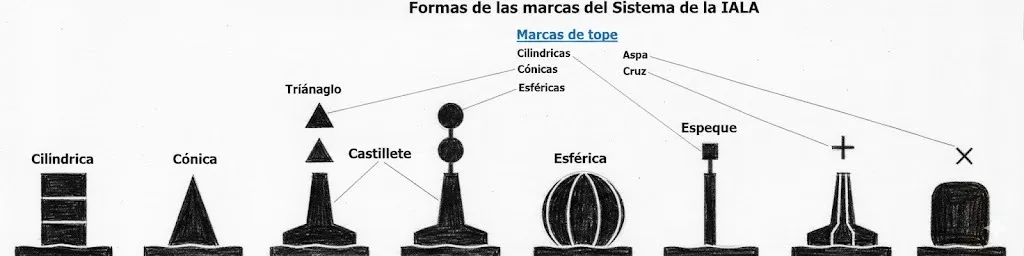
The problem comes at sunset. At night you cannot see the buoy: only its light, red or green. And there the shape no longer helps. That is why the restriction applies to night and not to day. The rest of the system is explained in our IALA buoyage guide and in cardinal marks, which, incidentally, are black and yellow with white lights and do not depend on red and green.
The eye sees green better than red
Even if you are not colour-blind, your eye does not see all colours equally. For the same energy, green looks considerably brighter to us than red: the eye is most sensitive to yellowish green and its sensitivity falls quickly towards red. And at night the gap widens, because as the eye adapts to the dark it shifts towards green and blue (the so-called Purkinje effect) and red fades first.
This has two very practical consequences on board. First: a distant red light, from a buoy or the side of another vessel, can be harder to spot than a green one; do not assume there is nothing to port just because you see no light. Second, the other way round: because the dark-adapted eye barely uses red, cockpit torches and chart-table lighting are red. They let you read without losing your night vision.