Cardinal marks: which side to pass and how to recognise them
The black and yellow buoys that mark a hazard, explained with the simulator from our online classroom: pick a mark and check which side you pass.
Ricard Prehn, professional skipper and yacht captain Updated 29 September 2026 8 min
Cardinal marks are black and yellow buoys that mark a hazard and tell you where to pass: you pass them on the side of their name. Leave a North cardinal to its north, an East cardinal to its east, and so on for all four; the hazard lies on the opposite side.
By day you recognise them by their two black cone topmarks, which point to where the black is on the buoy. At night, by their white light, which follows the hours of a clock: 3 flashes East, 6 plus a long one South, 9 West and continuous North. Below you have the classroom simulator to check it.
What is a cardinal mark?
It is a black and yellow buoy or beacon that warns of a hazard (a shoal, a rock, a wreck) and tells you on which side of it the safe water lies. There are four, one per cardinal point: North, East, South and West, and each is placed in that quadrant from the hazard.
Quadrants are counted from the hazard using true bearings: North runs from NW to NE, East from NE to SE, South from SE to SW and West from SW to NW. As well as marking a shoal or a rock, a cardinal mark can show the side with the deepest water or draw attention to a bend or the end of a shoal in a channel.
They are part of the IALA buoyage system, together with lateral marks (red and green), isolated danger, safe water, special marks and the new danger mark.
Which side do you pass a cardinal mark?
On the side of its name: pass a North cardinal to its north, an East cardinal to its east, a South cardinal to its south and a West cardinal to its west. The hazard lies on the opposite side. It does not matter which way you are heading or whether you are entering or leaving harbour.
The classic mistake is to think the buoy sits on top of the hazard and pass either side, or worse, pass between the mark and the hazard. The cardinal mark is not on the shoal: it is on its safe side. If you see a North cardinal, the shoal is south of it, and if you leave it to its south you head straight for it.
Do I leave it to port or to starboard? It depends on your heading, which is why the rule is the compass point and not the side of the boat. Example: heading south with an East cardinal ahead, you leave it to starboard to pass to its east; heading north, to port. And heading east with a South cardinal ahead, you leave it to port to pass to its south.
Try it right here
Which side do I pass the cardinal mark?
Pick the mark and press ▶: the boat passes through its safe quadrant. Switch to ☾ Noche (night) to see its light with the clock, and tick «Paso incorrecto» (wrong way) to see what happens if you cross between the mark and the hazard. (Like the classroom, it is in Spanish.)
Loading the demo…
This is one of the 90+ animations and simulators in the Aula Virtual, the online classroom of our PER/PNB course. It comes with the course, which is taught in Spanish: you start by paying €100 and the rest when you book the practical sessions.
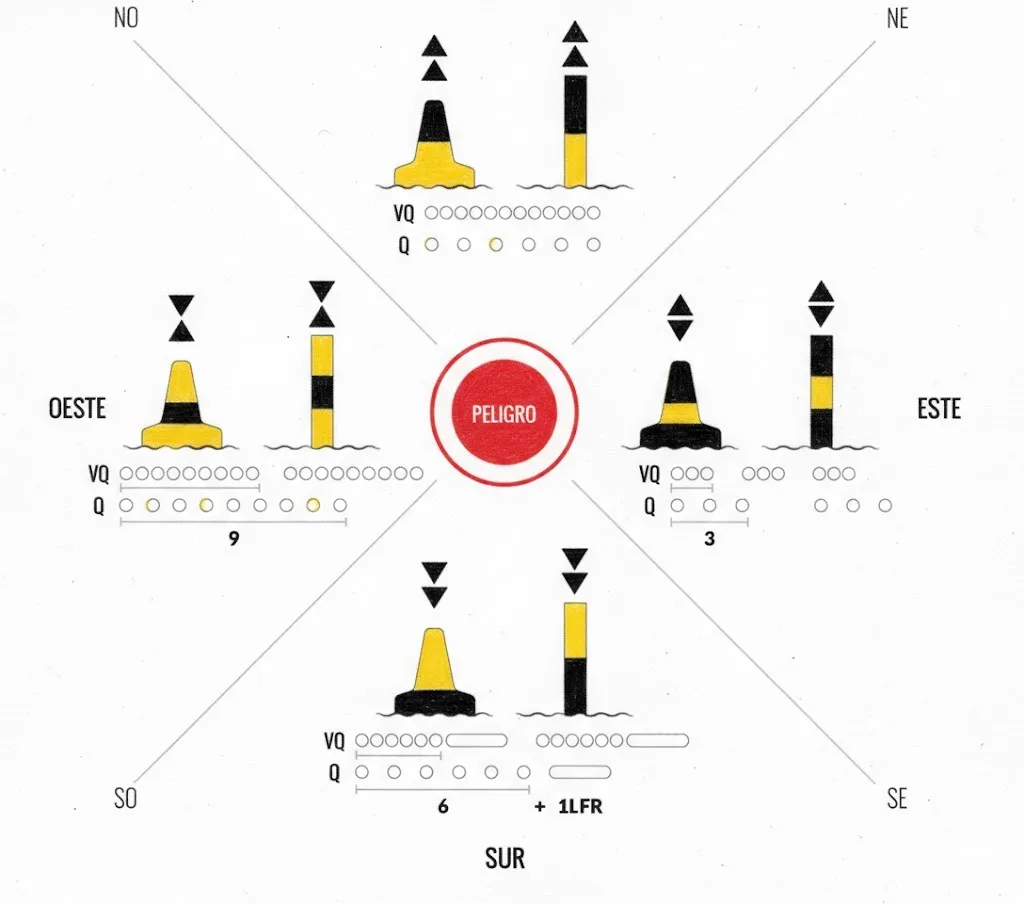
Each mark sits in the quadrant of its name from the hazard. Under each one, its light: VQ (very quick) and Q (quick).
North cardinal mark
Pass to its north: the hazard is to the south. Black above yellow; topmark, two cones pointing up (▲▲), like an arrow pointing north. At night, a white light flashing continuously, Q or VQ: 12 o'clock, with no pauses.
East cardinal mark
Pass to its east: the hazard is to the west. Black with a yellow band in the middle (black-yellow-black); topmark, two cones base to base (◆), a diamond shape. At night, 3 white flashes: Q(3) every 10 seconds or VQ(3) every 5. 3 o'clock.
South cardinal mark
Pass to its south: the hazard is to the north. Yellow above black; topmark, two cones pointing down (▼▼). At night, 6 flashes and a long flash: Q(6)+LFl every 15 seconds or VQ(6)+LFl every 10. 6 o'clock.
West cardinal mark
Pass to its west: the hazard is to the east. Yellow with a black band in the middle (yellow-black-yellow); topmark, two cones point to point (⧗), like an hourglass or a waist (W for West, W for waist). At night, 9 flashes: Q(9) every 15 seconds or VQ(9) every 10. 9 o'clock.
How do you recognise cardinal marks by day?
By their horizontal black and yellow bands and their topmark: two black cones, one above the other. North, both pointing up; South, both pointing down; East, base to base; West, point to point. Trick: the cones point to where the black is on the buoy.
With that rule there is nothing else to memorise: if the cones point up, the black is at the top (North); down, the black is at the bottom (South); if they turn their backs on each other (base to base), the black is at both ends (East); and if they face each other (point to point), the black is in the middle (West).
The cone topmarks are the most important daytime clue: they are the first thing you can make out against the light, before you can see the colours.
What light does each cardinal mark show?
Always white and flashing quick (Q) or very quick (VQ), following the clock trick: East, 3 flashes (3 o'clock); South, 6 flashes plus one long one (6 o'clock); West, 9 flashes (9 o'clock); and North, continuous flashing (12 o'clock).
Q (quick): 50 to 60 flashes per minute.
VQ (very quick): 100 to 120 flashes per minute.
LFl (long flash): a light of at least 2 seconds, the one that ends the South cardinal's group.
Why does the South cardinal have a long flash?
So that you do not mistake it for the East or West mark. Counting quick flashes at night is easy to get wrong: the long flash, lasting at least 2 seconds, marks the end of each group of 6 and makes it unmistakable.
Practical tip: when you see a white light flashing in groups, count out loud. If you do not get a clear number, wait for the next group before deciding, and confirm it on the chart, where the abbreviation (for example, Q(9)) is printed next to the mark.
Buoyage · At night
Count the flashes: which mark is it?
In «Ritmos de luz» (light rhythms) you pick the abbreviation (Q(3), Q(6)+LFl, Q(9)…) and watch it flash in time. In «¿Qué marca es?» (which mark is it?) you only see the light, at night: you answer and, at dawn, the buoy appears.
Loading the demo…
Loading the demo…
How are cardinal marks tested in the Spanish PER and PNB exams?
With a description or a drawing of the buoy (colours and cones) or with its light rhythm, and you are asked which mark it is or which is its navigable quadrant. The question about a white light with six quick flashes and a long one every fifteen seconds (South cardinal) has come up in several Barcelona and Girona sittings.
This one appeared in the Barcelona PER exam of March 2025 (model 1), in Spanish, translated:
"Heading east, we see ahead a yellow and black buoy whose topmark is two black cones one above the other with their points downwards. What is the navigable quadrant in relation to the buoy?"
a) North.
b) East.
c) South. (correct)
d) West.
Cones pointing down: South cardinal, so its navigable quadrant is south. The trap is the heading: going east changes nothing, because you pass a cardinal on the side of its name whichever way you are going. Another that keeps coming up: "a white light showing six quick flashes plus a long flash every fifteen seconds". That is the South cardinal, Q(6)+LFl; it came up in Barcelona in March and June 2024 and in the Girona PNB exam of May 2026.
In the online classroom you practise with real official exams from previous sittings, marked instantly. If you are planning your study, see how to pass the PER in a month.
Source: IALA maritime buoyage system (region A) and Topic 5 of Altair's PER syllabus.
Preparing for the Spanish PER or PNB?
The demos you just tried are part of the 90+ animations and simulators in the Aula Virtual of our PER/PNB course, along with a chart-work simulator and real official exams. The PER course costs €490 and is taught in Spanish; you start by paying €100 and the rest when you book the practical sessions on a real sailing yacht from Port Garraf.