Every week someone writes to me who has already searched for “PER licence Barcelona” on Google and ended up more confused than before: one page talks about the school, another about the Generalitat, another about the exam. Here is the whole process, just as we do it with our students, without assuming you already know what each part involves.
What exactly is the PER licence?
The PER, Patrón de Embarcaciones de Recreo (Recreational Boat Skipper), is the boating licence that lets you skipper motorboats up to 15 metres and up to 12 miles from the coast, valid in Spain and widely accepted around the Mediterranean. It is the most common licence for anyone who wants to skipper their own or a chartered boat without relying on anyone else on board. If you also want to sail, you need to add the sail endorsement, which is a separate block of practical training.
The three steps, in order
The process has three parts that move at very different speeds: one you do from the sofa, another on board a real boat, and the last one is set by the authorities on a fixed date.
1. The theory: 6 to 8 weeks, at your own pace
It is the longest part, but it doesn’t have to be the hardest. The syllabus covers buoyage, the COLREGs (the rules for not colliding with another boat), the nautical chart, weather, safety and engines. At our school you study online, with short videos and unlimited tests, and there is no fixed timetable: you log in when you can, on the metro or after dinner. On average our students take about two months in total for the whole process, although if you put in time every day you can shorten it considerably.
2. The practical sessions: 2 or 3 days on board
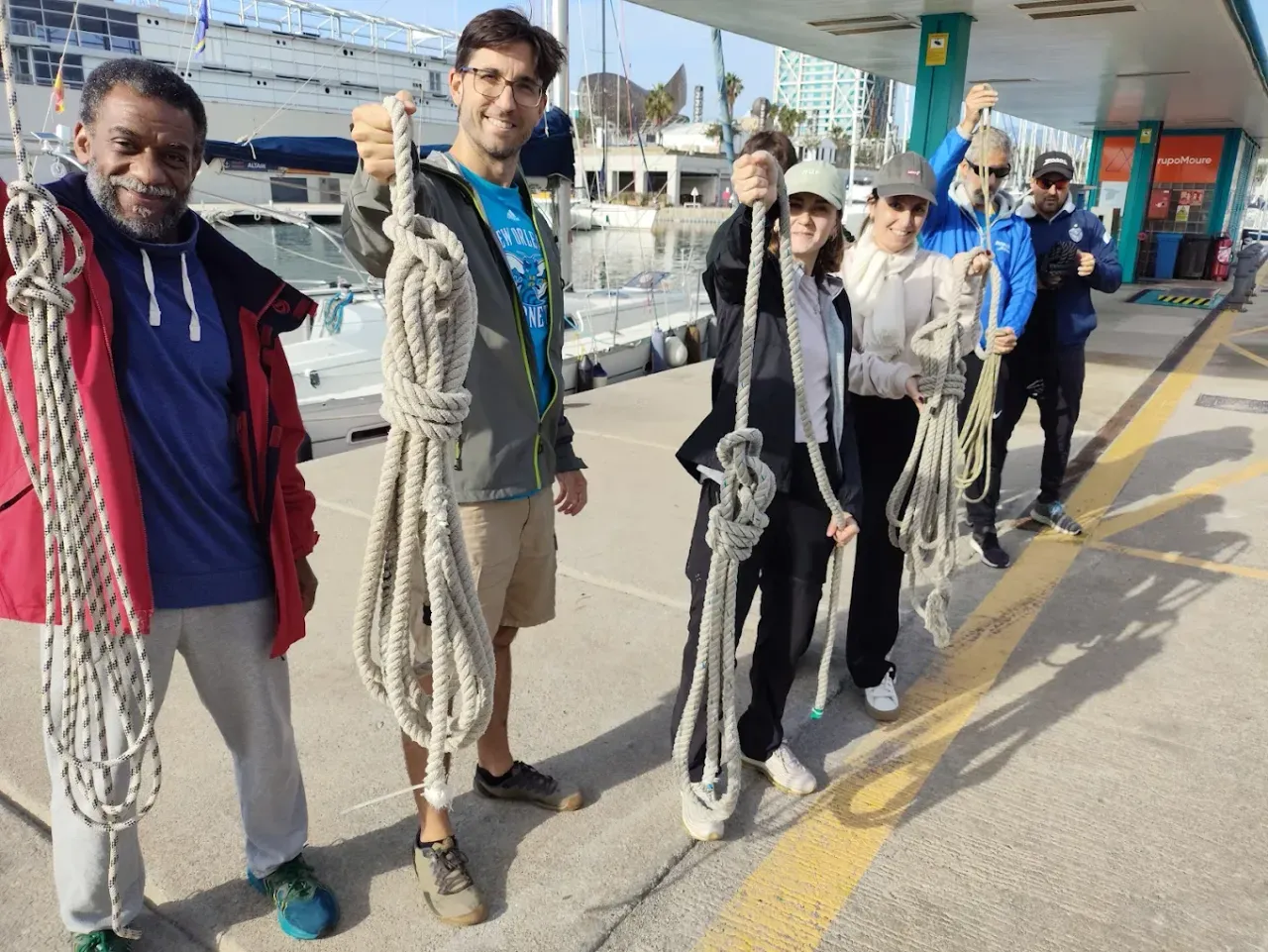
They are required by law and cannot be done in a simulator. There are 16 hours of navigation and safety —leaving and entering harbour, anchoring, a real man-overboard drill, night sailing— plus 12 hours of VHF radio, where you practise a full distress call and learn to use Digital Selective Calling. We do them aboard BELA, a 10.40-metre classic sailing boat that sails from Port Garraf, in Sitges, on Barcelona’s doorstep. If the sea isn’t cooperating, the outing is postponed at no cost; you never lose your money.
3. The exam: one day, and theory only
There is no practical exam for the PER, only a theory one. It is set by the Generalitat de Catalunya, usually in Barcelona, Girona or Tarragona, almost every month and with no limit on places. If you fail, it isn’t the end of the world: you can keep the modules you have already passed and sit only what’s left at the next session.
What it really costs
This is where people get most confused, because there are two payments that don’t go to the same place.
- The course: what you pay the school for the training, the practical sessions and the materials. With us it’s €490 in total, split into €100 when you enrol and €390 when you book the practical sessions.
- The official fees: what the Generalitat charges to examine you and issue the licence, about €142 today. No school collects them; they go straight to the authorities. If you don’t want to wrestle with the e-government forms, some schools, ours included, handle them for you for a token amount.
What to check before enrolling at any school
Wherever you do it, these three things make the difference between a good course and a bad one:
- What happens if you fail the exam? Some schools charge you for the course again. We don’t: you keep access to the virtual classroom until you pass, whether it takes one exam session or three.
- Are the practical sessions on a real boat? Some courses cut them to the legal minimum on a generic school boat. Ask which boat you’ll be on and who will be with you.
- Is it the same instructor from start to finish? Changing teacher halfway through is common at large schools, and it shows in the continuity of your learning.
Start for €100
Get into the virtual classroom today and book the practical sessions when it suits you. The rest of the €490 is paid when you book. See the full PER course