Published on · By Ricard Prehn, professional recreational skipper (PPER), Spanish Yacht Captain (capitán de yate), Yacht Captain up to 200 GT and sailing instructor for over 27 years
In short
Choose the cove before you get there, using the chart and the pilot book: it should shelter you from the wind and the swell you're going to get, with a sand bottom and no seagrass, and it must not be a lee shore.
When you arrive, motor slowly around and work out where everyone else's anchor is: ahead of their bow, at roughly 3-5 times the depth. Anchor outside their swing circles, usually behind the group, with your bow pointing where you'll end up lying.
Watch out for boats that swing differently from you: a boat on a mooring buoy barely moves, a catamaran on a bridle does its own thing and a large yacht with lots of chain sweeps a huge circle. With the same wind you don't touch; when it shifts, you do.
First, the cove: choose it before you get there
Half of a good anchorage is decided at home. Look at the nautical chart and the pilot book for the area: the usual anchorages are marked, and the pilot book tells you which winds each cove is sheltered from. Very few coves are sheltered from everything, so the question is: what wind and what sea am I going to have this afternoon and tonight?
What you’re looking for, in this order:
- It must not be a lee shore. If the wind is blowing onto the coast, any anchor failure puts you on the rocks. A cove with the wind blowing off the land is a different story.
- Shelter from the swell, not just the wind. In the Mediterranean there are coves without a breath of wind where the boat rolls all night because of the swell coming in from outside.
- Enough depth for your boat, but no more than you need: the deeper it is, the more chain and the bigger the circle. In the Mediterranean the tide hardly matters, but in the Atlantic you have to check low water.
- Good holding: sand or mud. Never on top of Posidonia seagrass, which is protected and holds badly anyway. More in sustainable anchoring and Posidonia.
And always keep out of the buoyed swimming areas off the beaches: the yellow buoys aren’t decoration.
Every boat swings in its own circle
An anchored boat isn’t still: when the wind shifts, it swings around its anchor. The radius of that circle is roughly the chain it has out plus its length. In 5 metres of water with 5 times the depth in chain, a 10-metre sailboat sweeps a circle of about 34 metres radius. We explain it with numbers in how much chain to let out when anchoring.
The problem is that not all circles are the same:
- A sailboat like yours, with the same scope, swings at the same time as you and by about the same amount. If there’s some water between you, it doesn’t matter if the circles overlap a little.
- A catamaran usually lies to a bridle (a Y-shaped line to both hulls) and feels the wind more than the current: it often swings a little less and at a different pace.
- A boat on a mooring buoy swings in a very small circle. If you anchor close by thinking “it’s far enough”, when the wind shifts you’ll move 30 metres and it will hardly move at all.
- A large yacht anchored in deeper water with lots of chain sweeps a huge circle. Its anchor can be much further away than it looks.
With the wind on the nose, everyone points the same way and there seems to be plenty of room. The trouble starts when it shifts, and in Mediterranean coves it shifts almost every night: the afternoon sea breeze dies and the land breeze comes in.
Simulator: where do I anchor in this cove?
There are four boats at anchor: a sailboat, a catamaran, a boat on a mooring buoy and a yacht. Try spots A, B and C, or tap the water to anchor wherever you like, and press Shift the wind. With the circles showing, you’ll see straight away why the spot that looked clear wasn’t.
Pick a spot and press «Shift the wind».
…or tap the water to anchor wherever you like.
A teaching model: approximate radii, no current or waves. In real life, each boat also reacts with its own delay.
How to position yourself in a cove with other boats
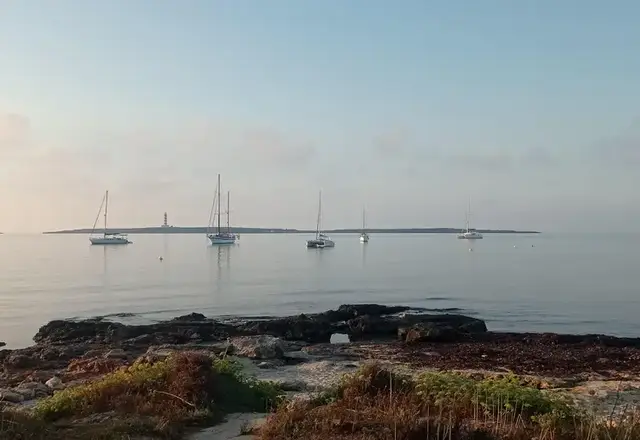
- Motor slowly around before anchoring. Look at how the others are lying and which way they’re pointing.
- Work out where their anchors are. They’re ahead of their bows, where the chain leads, at roughly 3-5 times the depth. If a boat is pointing north, its anchor is to the north of it, not underneath.
- Make a mental map of the cove: each anchor with its circle. Your spot is where your circle doesn’t overlap a mooring buoy, a catamaran or a yacht, the shore or the swimming area.
- Usually, the spot is behind the group. Approach from behind the last boat and drop your anchor roughly level with its stern. As you let out chain you’ll fall back and end up behind it, outside its circle. Never in front: you’d fall back over its anchor.
- Come in with your bow pointing where you’ll lie, that is, into the wind, or into the current if that’s what dominates, and stop the boat right on the chosen spot.
- Drop the anchor and pay out chain gradually, as we explain in the anchoring manoeuvre step by step.
If there’s someone on deck as you approach, say hello. It’s a good moment to ask how much chain they have out: it’s normal, and it clears up any doubts.
Check that the anchor has set
With the anchor on the bottom and the chain paid out, give a gentle burst astern. Put your hand, or your foot, on the chain: if you feel jerky vibrations, the anchor is dragging. If the boat stops and the bow points towards the anchor, it has set.
Then take two transits on shore and set the anchor alarm. And if after a while you see you’ve ended up too close to someone, don’t wait until nightfall: weigh anchor and re-anchor. Five minutes now saves you a nasty wake-up call.
What happens in Mediterranean coves in summer
In July and August, in the coves of the Garraf or the Costa Brava, the problem is hardly ever the wind: it’s the crowds. Boats anchored right next to each other, motorboats arriving late and squeezing into any gap, and the land breeze coming in at dawn and turning everyone round to face another way.
Three tips from someone who has seen it many times:
- Arrive early at the good coves: by midday, the best spot is taken.
- If you’re torn between two gaps, choose the wider one, even if it means a longer swim to the beach.
- Before going to sleep, check the forecast and think about what will happen if the wind shifts 180°. If the answer is “I end up on the rocks”, move now.
On our PER practical sessions we anchor for real in the coves of the Garraf: we choose the spot, work out the others’ circles, anchor and weigh anchor. It’s the best way to make all of this stick.
Frequently asked questions
How much distance should I leave from another anchored boat?
Enough that your swing circles don't overlap. If you are both similar sailboats with the same scope, you'll swing together and can lie a little closer than the sum of the circles. If the other boat is on a mooring buoy, is a catamaran or a yacht with much more chain, leave its whole circle clear: when the wind shifts, each of you will end up somewhere different.
Where is an anchored boat's anchor?
Ahead of its bow, where the chain is pointing. How far depends on how much chain it has out: in 5 metres of water with 3 to 5 times the depth in chain, between 15 and 25 metres ahead of the bow. If in doubt, ask: between anchored boats it's normal and appreciated.
Why do boats in the same cove point in different directions?
Because they don't all respond the same way to wind and current. A deep-keeled sailboat feels the current more; a catamaran or a motorboat, with lots of freeboard, feels the wind. A boat on a mooring buoy swings in a very small circle. That's why, when the wind shifts, two boats that were far apart can end up very close.
Can I anchor in front of another boat?
Better not. Your boat would fall back over their anchor and chain, and you could foul it when weighing anchor. The right way is to anchor behind the group or to one side, dropping your anchor roughly level with the stern of the boat ahead: as you fall back on your chain, you end up behind it, outside its circle.
What do I do if someone anchors too close to me?
Tell them politely as soon as they anchor, not at three in the morning. Whoever arrives last is the one who has to move. If the wind has already shifted and you're close, get your fenders ready, have the engine on standby and, if need be, weigh anchor yourself and re-anchor: it's quicker than arguing.