





Published on · By Ricard Prehn, industrial engineer, professional recreational skipper (PPER), Spanish Yacht Captain and sailing instructor for over 27 years; he carries out Escuela Náutica Altair’s pre-purchase surveys
When buying a used boat, check in this order: hull and keel (blisters, impacts, cracks), interior (smells, bilge, wiring, seacocks), engine started from cold (smoke, oil, water from the exhaust), rigging and sails (age and corrosion) and a sea trial. Then the paperwork: in the seller’s name and free of charges.
On top of the price, budget for Transfer Tax (ITP): 5% in Catalonia of the boat’s value if you buy from a private seller (a company’s price already includes VAT), the agency fees for the change of ownership, insurance and the first maintenance. This list helps you rule boats out; before you pay, what protects you is a survey.
This is the list I would give you if you came with me to view a boat. It does not replace a survey — it measures no moisture and opens nothing — but it teaches you to rule out in one morning the boats that are not worth a surveyor’s visit. For the mistakes that cost most, see mistakes when buying a used boat.
Bring a torch, a rag, your phone to photograph everything and, if you can, someone who has not fallen in love with the boat.
1. Before you go: questions on the phone
They save you trips. If the seller does not know or will not answer, that is an answer too.
- Is the boat in your name? Why are you selling?
- When was it last hauled out and what was done? Do you have the invoices?
- Engine hours, last oil change, impeller and, on a saildrive, the inner seal (diaphragm).
- How old is the standing rigging? And the sails?
- Can I see it out of the water and start the engine from cold?
2. Hull, keel and deck
Look at it out of the water if you can. A freshly painted hull is not good news until you know why it was painted.

- Blisters below the waterline: possibly osmosis. If they weep liquid that smells of vinegar, that is a bad sign.
- The keel-to-hull joint: a crack shaped like a “smile” at the front of the keel points to a grounding or impact. Check the keel bolts inside too.
- The rudder: move it by hand. Play in the stock or cracks in the blade — note it down.
- Deck: walk over it. A spot that gives underfoot usually means a wet or rotten core.
- Stanchions, pulpits and fittings: push them. If they move, water is getting in through their bolts.
- Gelcoat crazing: on older boats it is usually cosmetic; star cracks next to fittings, less so.
Osmosis is not always visible: a hull can be wet inside without a single blister. More in how to detect osmosis (in Spanish).
3. The interior: nose, bilge and wiring
Step in and smell before you look. Your nose spots in a second what the seller spent a week cleaning.
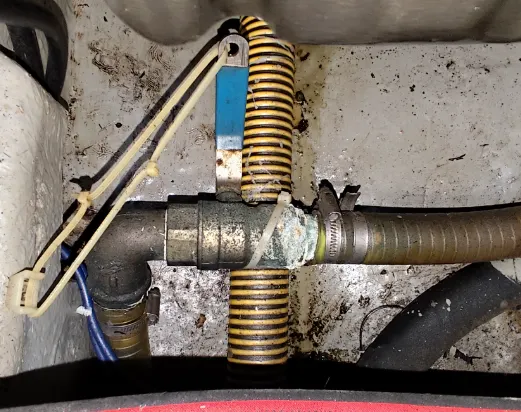
- Smells: diesel (leaks), damp and mould (water ingress), sewage (holding tank or hoses).
- The bilge: a little water is normal; oil, diesel or seawater that comes back after pumping is not.
- Dark or swollen wood around portlights, chainplates and the mast step: that is where water gets in.
- Seacocks: they must open and close, with double hose clamps. If they are original on a boat over ten years old, budget for replacing them.
- Bilge pumps: there must be an electric and a manual one. Pour water into the bilge and test them.
- Wiring: joints wrapped in insulating tape, scorched cables or a tangle behind the panel mean work (and fire risk).
- Batteries: check the date. Lead-acid batteries last 4 or 5 years; with no invoice, plan to replace them.
4. The engine: always from cold
Ask them not to start it before you arrive. A warm engine hides starting problems and much of the smoke.
- Starting: it should fire first or second time, without odd jerks or metallic knocks.
- Water from the exhaust right away. If none comes out, stop the engine.
- The smoke: persistent blue or black is a bad sign (explained below).
- The dipstick: oil that looks like milky coffee means water inside.
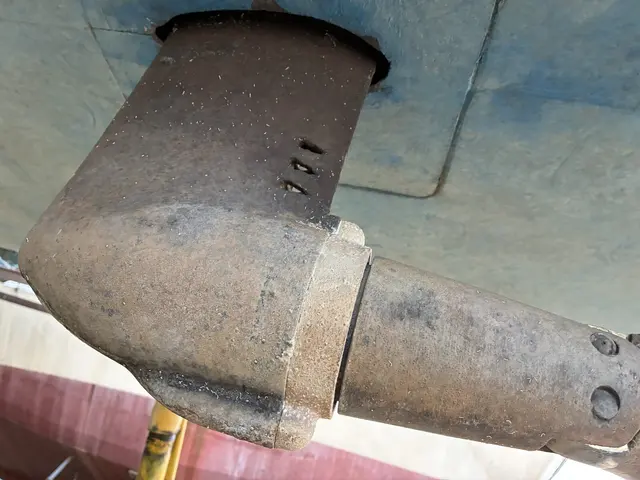
- Rust and salt crust on the exhaust elbow, clamps and under the engine: old leaks.
- Saildrive: the inner seal (diaphragm) is replaced by age, not hours. Yanmar’s SD-series manual says every 6 years at most; with no invoice, assume it is original.
- Hours: they should match its look. Very few hours on a twenty-year-old engine is a warning too: long periods laid up.
Which exhaust smoke colour is bad on a boat engine?
A little white smoke on a cold start is normal. Bad signs are bluish smoke (burning oil), black smoke that does not clear as revs rise (poor combustion, overload or the wrong propeller) and dense white smoke that persists when warm (possibly water in the combustion). Water must always come out of the exhaust: if it does not, stop the engine.
5. Rigging and sails
On a yacht, the mast is the most expensive thing that can fall down. Look up, even if you would rather not.
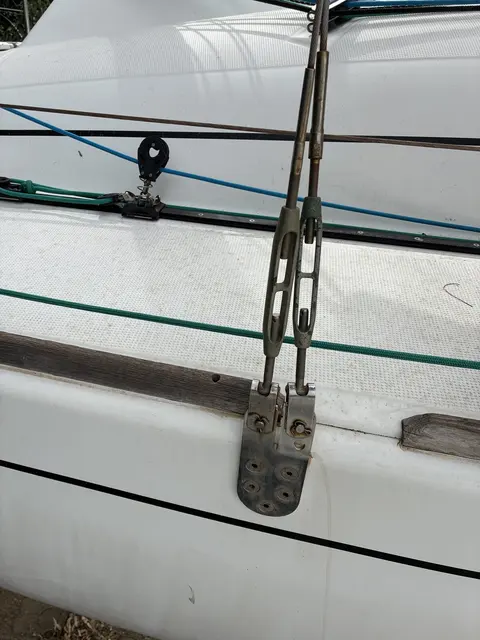
- Rigging age: it is usually replaced about every ten years. And many comprehensive policies only cover a dismasting if the rigging is under ten years old and an invoice proves it.
- Swaged terminals: look for broken strands where the wire enters the fitting and hairline cracks in the fitting itself.
- Turnbuckles and chainplates: rust, open split pins or distorted plates.
- Mast foot: white corrosion on the aluminium, especially where it touches stainless steel.
- Sails: unroll them. Stiff cloth or cloth that tears with a fingernail, sun-burnt stitching and a perished UV strip.
6. The sea trial
Many problems only show up underway. If the seller will not go out, ask yourself why.
- Engine at several speeds, including a while at full throttle: no odd vibration, no overheating, no black smoke.
- Ahead and astern, switching several times: the lever and gearbox should engage without clunks.
- The steering: no play or stiffness in the wheel or tiller.
- On a yacht, hoist and trim the sails: winches, windlass and furlers must all work.
- Back at the berth, check the bilge again: did water come in while sailing?
7. The paperwork
The registration certificate and navigation permit, proof of ownership, the entry sheet from the Harbour Master’s office (Capitanía Marítima), the seaworthiness certificate or CE marking, proof that VAT and registration tax were paid, the radio licence, invoices and manuals for the engine and equipment, and the seller’s ID. Also ask for an extract (nota simple) from the Ships Section of the Movable Property Registry to check for mortgages or seizures.
- The boat must be in the seller’s name. If it belongs to a company, several heirs or “a friend”, it gets complicated.
- No charges or seizures. By requesting an extract from the Ships Section of the Movable Property Registry. Careful: for leisure boats registration there is voluntary, so a clean extract does not prove the boat is free. Ask the seller to show the berth and harbour fees are paid, and make the contract state that any debt from before the sale is theirs.
- The seaworthiness certificate must be in force and the safety gear on board must match the area you plan to sail. What must be carried is in compulsory boat documents (in Spanish).
- Foreign flag (Polish, for example): Spanish registries tell you nothing about its debts. Read what is changing with the Polish flag (in Spanish) first.
- The berth: in many marinas it does not go with the boat, because it is a contract or concession in the seller’s name. Ask before assuming where you will keep it.
- The contract, in writing. And if the boat is entered in the Movable Property Registry, before a notary. The change of ownership at the Harbour Master’s office is usually handled by a nautical agency (gestoría).
8. What it costs on top of the price
If you buy from a private seller, Transfer Tax (ITP), which in Catalonia is 5% of the boat’s real value — not always the agreed price. If a company sells it, there is no ITP: the price includes 21% VAT. The registration tax is not paid again on a second-hand purchase, except in special cases.
| Cost | How much |
|---|---|
| Transfer Tax (private seller) | 5% of real value in Catalonia (other regions differ) |
| VAT (company seller) | 21%, already in the price; no ITP |
| Registration tax | Not paid again second-hand, except special cases |
| Change of ownership | Harbour Master fees plus agency fees |
| Survey | At Altair, from €550 |
| Third-party insurance | Compulsory from day one |
| Berth and first maintenance | Whatever the viewing and survey turned up |
Note the ITP base: it is the boat’s real value, which does not always match the contract, and the tax office can review it. For yearly running costs, see annual boat maintenance costs (in Spanish).
Red flags to walk away
- They will not let you see it out of the water or start the engine from cold.
- They do not want a surveyor to see it, or rush you because “there is another buyer”.
- The papers are not in their name or cannot be found.
- The price is far below similar boats with no clear explanation.
- Freshly painted hull, freshly cleaned bilge and a warm engine when you arrive. All at once.
If the boat passes your viewing
It is not compulsory, but it is the best money you will spend on the purchase. Your viewing rules boats out; the survey stops you buying a problem: it measures hull moisture, checks what you cannot see and gives you a written report to negotiate the price. Do it before signing and paying a deposit, or make the survey a condition of the deposit agreement.
What a surveyor checks, point by point, is in what a marine surveyor checks (in Spanish), and what we have found on real boats in our survey case studies.
FAQ
What should you check when buying a used boat?
In this order: hull and keel (blisters, impacts, cracks), interior (damp, smells, bilge, wiring), the engine from cold (smoke, oil, hours), rigging and sails (age and corrosion), a sea trial and the paperwork (the boat must be in the seller’s name and free of charges). If the boat passes your first viewing, the next step is a survey before you pay.
What tax do you pay when buying a used boat in Spain?
If you buy from a private seller, Transfer Tax (ITP), which in Catalonia is 5% of the boat’s real value — not always the agreed price. If a company sells it, there is no ITP: the price includes 21% VAT. The registration tax is not paid again on a second-hand purchase, except in special cases.
What papers must the seller give me?
The registration certificate and navigation permit, proof of ownership, the entry sheet from the Harbour Master’s office (Capitanía Marítima), the seaworthiness certificate or CE marking, proof that VAT and registration tax were paid, the radio licence, invoices and manuals for the engine and equipment, and the seller’s ID. Also ask for an extract (nota simple) from the Ships Section of the Movable Property Registry to check for mortgages or seizures.
How do I know if a boat has debts or is under seizure?
By requesting an extract from the Ships Section of the Movable Property Registry. Careful: for leisure boats registration there is voluntary, so a clean extract does not prove the boat is free. Ask the seller to show the berth and harbour fees are paid, and make the contract state that any debt from before the sale is theirs.
Do you need a surveyor to buy a used boat?
It is not compulsory, but it is the best money you will spend on the purchase. Your viewing rules boats out; the survey stops you buying a problem: it measures hull moisture, checks what you cannot see and gives you a written report to negotiate the price. Do it before signing and paying a deposit, or make the survey a condition of the deposit agreement.
General information, updated October 2026. Taxes and procedures depend on the region and on each case: confirm them with your agency before signing.