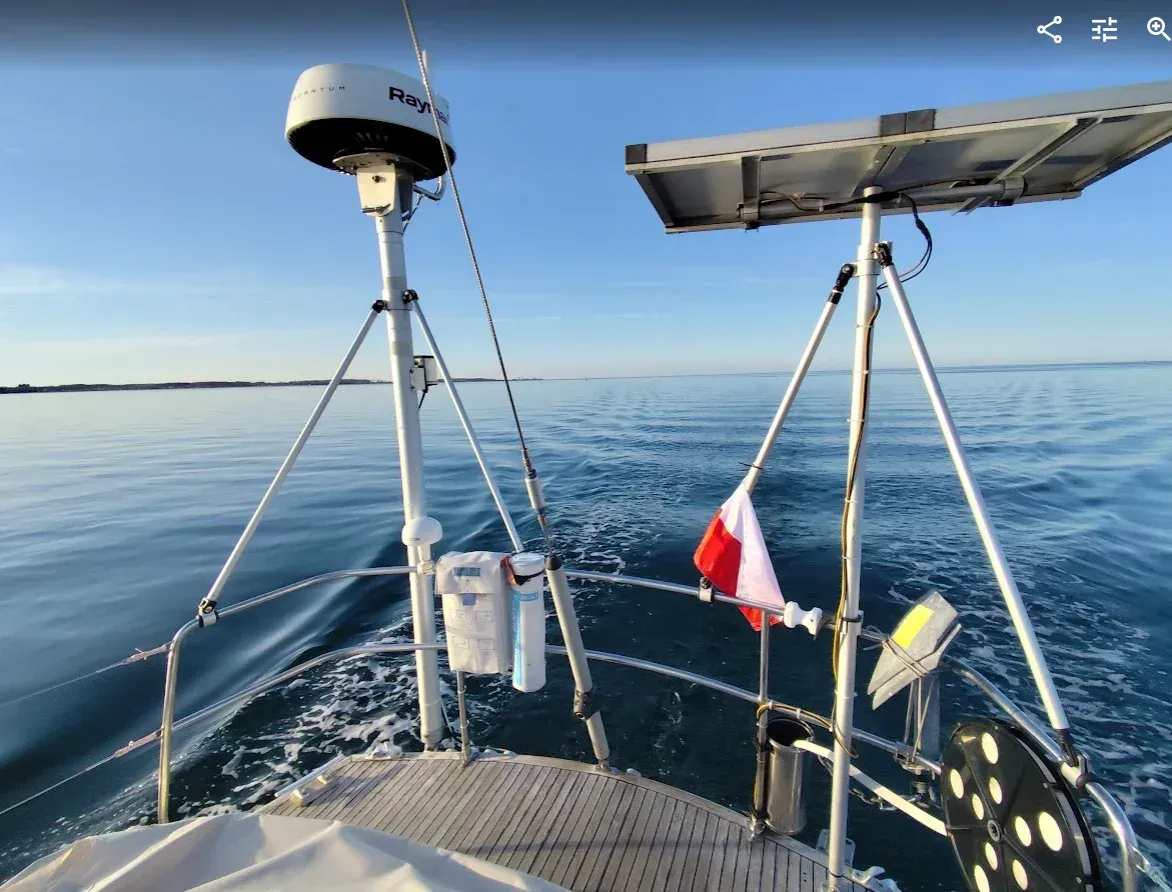
Sailing is an art, but it is also a science. At Escuela Náutica Altair we believe in knowing our working tool inside out: the Finnsailer 34 “BELA”.
This classic boat, designed by the legendary Finnish naval architect Hans Groop and built in 1979, stands out for its strength (Lloyd’s certification) and its seakeeping. But how fast does it really go on each point of sail?
Official ORC data
To answer that with scientific precision, we use the data from the official ORC (Offshore Racing Congress) measurement certificate. These figures set out the boat’s theoretical speed potential in ideal conditions.
Original data source: ORC International Certificate (Ref: 181568)
The speed table
These are the figures from the certificate: for each true wind strength, the best angle to sail upwind and the boat’s speed on each point of sail.
| True wind | 6 knots | 8 knots | 10 knots | 12 knots | 14 knots | 16 knots | 20 knots |
|---|---|---|---|---|---|---|---|
| Optimum upwind angle | 47,1° | 45,6° | 45,4° | 45,0° | 45,3° | 45,4° | 46,0° |
| Upwind VMG (knots) | 2,61 | 3,16 | 3,55 | 3,81 | 3,95 | 4,03 | 4,05 |
| A 52° | 4,12 | 4,93 | 5,49 | 5,88 | 6,09 | 6,20 | 6,28 |
| A 60° | 4,44 | 5,24 | 5,80 | 6,16 | 6,38 | 6,50 | 6,61 |
| A 75° | 4,65 | 5,47 | 6,05 | 6,42 | 6,65 | 6,81 | 6,99 |
| A 90° | 4,61 | 5,47 | 6,11 | 6,51 | 6,76 | 6,96 | 7,24 |
| A 110° | 4,28 | 5,23 | 5,99 | 6,49 | 6,81 | 7,06 | 7,47 |
| A 120° | 4,09 | 5,05 | 5,82 | 6,38 | 6,73 | 7,00 | 7,46 |
| A 135° | 3,66 | 4,62 | 5,40 | 6,05 | 6,51 | 6,81 | 7,28 |
| A 150° | 3,14 | 3,99 | 4,74 | 5,38 | 5,94 | 6,36 | 6,92 |
| Downwind VMG (knots) | 2,72 | 3,50 | 4,27 | 4,94 | 5,55 | 6,07 | 6,76 |
| Optimum downwind angle | 144,8° | 169,4° | 171,2° | 172,1° | 173,0° | 174,8° | 177,2° |
How to read this chart
The polar diagram (or “polar curve”) shows the boat’s speed (radial axis, in knots) for each true wind angle (angular axis, in degrees).
- 0° (top): head to wind.
- 180° (bottom): dead downwind.
- Coloured lines: these show different true wind speeds (TWS), from 6 to 20 knots.
It is clear that the Finnsailer 34, as a heavy-displacement motorsailer, performs best on a beam reach and broad reach (90° to 130°) and stays stable when the wind picks up.
What the numbers say
- It sails upwind at about 45° to the true wind in almost any strength, and its upwind VMG levels off at around 4 knots from 14 knots of wind upwards: more wind no longer makes it go faster against it.
- Its fastest heading is 110° in 20 knots: 7.47 knots. On a beam reach (90°) in the same breeze it does 7.24.
- In a light breeze (6 knots) the best heading is a close reach, at about 75°, at 4.65 knots. Dead downwind in light airs it is slow, which is why in a light breeze it pays to gybe downwind on broad reaches.
- Beyond 16 knots the curves almost merge: the hull is nearing its hull speed and more wind turns into heel, not speed. Time to reef.
All of this is in true wind. On board, the anemometer shows apparent wind, which upwind is stronger and further forward: we explain it in true wind and apparent wind.