Published on · By Ricard Prehn, professional recreational skipper (PPER), Spanish Yacht Captain (capitán de yate), Yacht Captain up to 200 GT and sailing instructor for over 27 years
In short
A sailboat's tender is usually an inflatable with no keel and a 2 to 6 HP outboard. Put it ahead, pulling on a line, and every jerk throws it to one side and then the other: the sailboat yaws from side to side and you cannot control it.
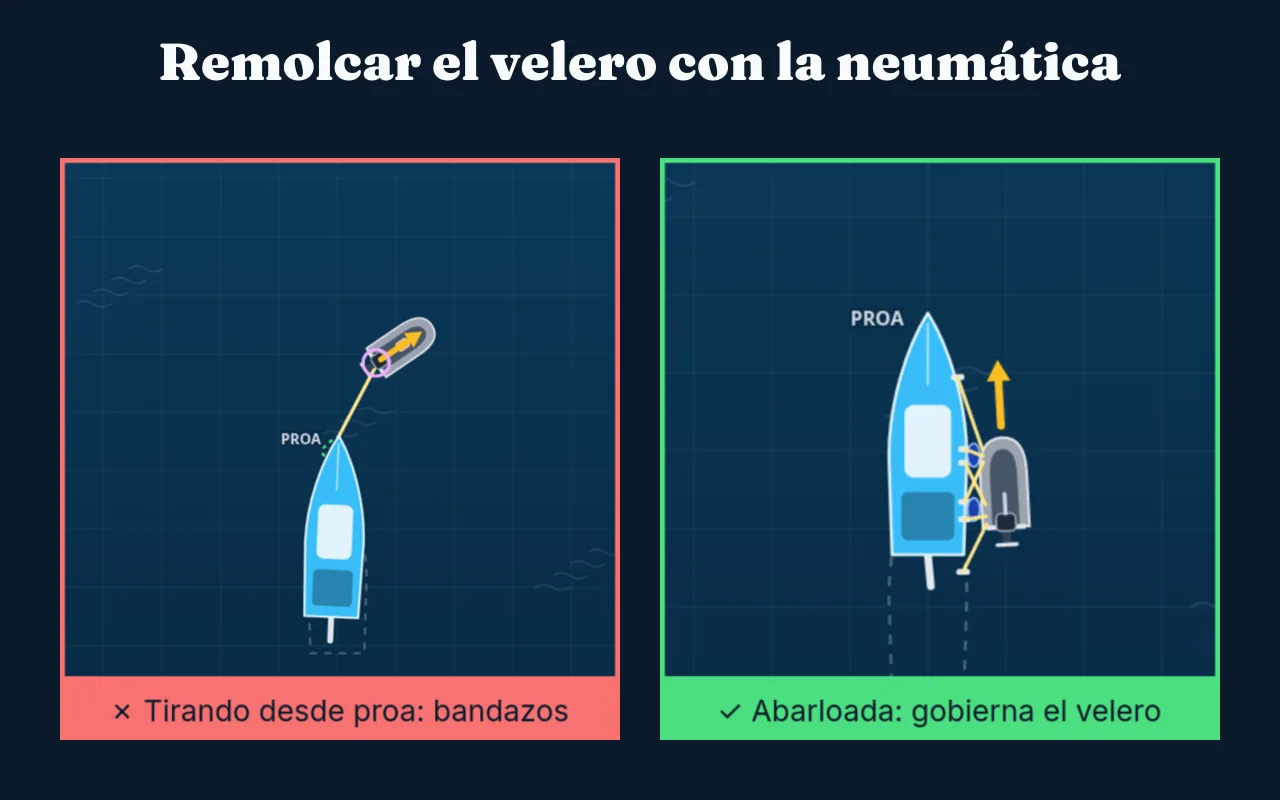
What works is to hip tow it alongside, by the quarter, with fenders and a bow line, stern line, breast lines and springs to the cleats. The dinghy only pushes and you steer with the sailboat's rudder. With the throttle fixed and the outboard tiller held by its friction screw, you can do it single-handed.
What happened to the sailboat in the video
The crew of Reversing Entropy, who are sailing round the world in a ketch from the eighties, were leaving an anchorage when a line wrapped round the propeller. They were close to the beach, with other boats next to them, and the current was pushing them towards all of it. They could not drop the second anchor right there: they would have ended up on top of their neighbours.
So the skipper jumped into the dinghy, tied a line from the dinghy to the sailboat’s bow and opened the throttle. It did not work: there was no way to control where the boat went.
It can happen to you in any cove: a mooring line, a piece of net, an engine that will not start. And the dinghy is all you have to move the boat. It pays to know beforehand how to lash it on.
Try it: ahead or alongside
Choose where the dinghy goes and where you want to take the sailboat, then press ▶.
Loading the demo…
Why pulling from the bow does not work
Because a sailboat’s dinghy is not a tug. It is almost always an inflatable with no keel and a small outboard, 2 to 6 horsepower.
When you pull from ahead, the line goes taut and the sailboat, which weighs far more, stops the dinghy dead. With no keel to hold it, the inflatable is thrown to one side. The line goes taut again and throws it to the other. You lurch from side to side, and so does the sailboat behind you.
It does not matter what you do with the tiller: there is no way to take it straight or to turn when you want. And the more throttle you give, the harder the jerks.
In the video they also try pulling from the bow in reverse. We do not recommend it: it is dangerous.
How it is done: the dinghy alongside
The dinghy is lashed to the sailboat’s side, instead of pulling it. In English this is called a hip tow; in Spanish, abarloada.
- Fenders on the sailboat’s side, at the height of the inflatable.
- Put the inflatable by the quarter, on the aft part of the side, with the outboard towards the sailboat’s stern.
- Tie it to the sailboat’s cleats with everything: bow line, stern line, breast lines and springs. Make them snug: the dinghy and the sailboat have to move as one. If it is slack, it jerks.
- Start the outboard, set the throttle fixed and hold the tiller with the friction screw, straight.
- Climb aboard the sailboat and steer with its rudder. The dinghy only pushes; with the boat moving, the sailboat’s rudder is far stronger than the outboard.
That way you can do it single-handed. Mind you, with nobody at the outboard to cut the throttle, do it with clear water around you and at low speed.
Turning towards the dinghy’s side takes more helm
The push comes from one side, so it tends to take the boat the other way. If the inflatable is on the starboard side, turning to port is easy and turning to starboard takes more helm. You will see it in the simulator.
If you know you will have to turn a lot to one side, for example to enter the harbour mouth, lash the inflatable on the other side.
Before you start towing
- Anchor or move? If you have clear water to leeward, anchoring is the quickest way to stop drifting. If anchoring there puts you on top of another boat or the beach, as in the video, first get clear and anchor after.
- Do not jump in the water to free the propeller with the boat drifting towards the rocks. Boat stopped and safe first.
- Call. A call on channel 16 to the boats around you helps them get out of the way or lend a hand. If it gets serious, Salvamento Marítimo is on the same channel 16.
- Clear lines. A loose line in the water is exactly what you do not want near the inflatable’s propeller.
Frequently asked questions
Why can't you tow a sailboat by pulling from the bow with the dinghy?
Because the inflatable has no keel and the engine is small, 2 to 6 HP. When the line goes taut, the sailboat, which weighs far more, stops it dead and throws it to one side; then to the other. The dinghy yaws, the sailboat behind it too, and there is no way to take it straight or to turn when you want.
What is a hip tow?
Carrying the other boat lashed to your side, instead of pulling it on a line. With the dinghy: it is tied by the sailboat's quarter, with fenders, and secured to the cleats with a bow line, a stern line, breast lines and springs, all snug so that both boats move as one. The outboard pushes and the sailboat steers with its own rudder.
Can I tow the sailboat with the dinghy if I am alone?
Yes, alongside. Leave the outboard with the throttle fixed and the tiller held by the friction screw, climb aboard the sailboat and steer with its rudder. Do it with clear water around you, because there is nobody at the outboard to cut the throttle.
Which way does a sailboat turn best with the dinghy alongside?
Away from the dinghy. The push comes from one side, so it tends to turn the boat the other way: if the dinghy is on the starboard side, turning to port is easy and turning to starboard takes more helm. If you know you will have to turn a lot to one side, lash the dinghy on the opposite side.
What about pulling from the bow in reverse, as in the video?
We do not recommend it: it is dangerous. To move the sailboat with the dinghy, always alongside.
Is it better to anchor or to tow if I lose the engine near other boats?
It depends on the spot. If you have clear water to leeward, anchoring is the quickest way to stop drifting. If anchoring there would drop you onto another boat or onto the beach, as happened to the author of the video, first move the boat to a clear spot and anchor after. And if you are not sure, ask for help on VHF channel 16.