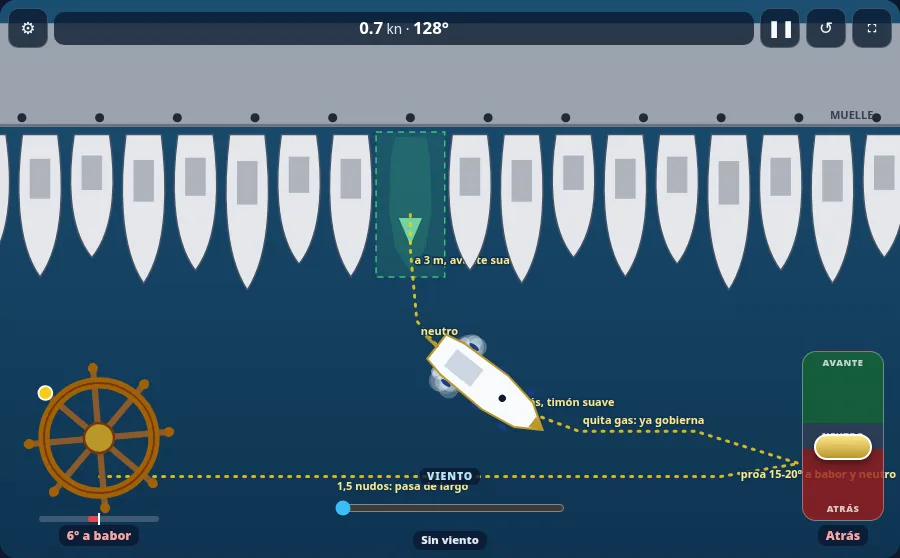
In short: stern-first only with no wind and if you know the boat; otherwise bow-first, which is easy even in a strong wind. Keep it simple and make sure you get it right. The manoeuvre: go about 30 m past the berth, angle the boat 15-20° against the side the propeller will walk you to and let her stop in neutral; go astern steadily (for the first 10 m she will not steer), ease off once she has way, make the turn with very little helm, go in in neutral and 3 m out go gently ahead to stop a metre off. Lines to the marina staff you called beforehand, and the lazy line by hand.
Ricard Prehn, yacht captain and sailing instructor for more than 27 years, teaches it in the manoeuvring lessons at Escuela Náutica Altair in Port Garraf (Sitges), €250 for a 2-hour session. And you can try it below in the simulator.
What is stern-to or Mediterranean mooring?
It is the usual way of mooring in Mediterranean marinas: the boat lies at right angles to the quay, stern a metre off it held by two stern lines, and the bow held by a lazy line (a line running to a concrete block on the bottom) instead of a finger pontoon. Many boats fit along a short quay and you step ashore over the stern on the passerelle.
First: stern-first or bow-first?
Stern-first, only when the wind is practically calm and you know the boat and how she behaves astern. If there is wind, or you do not know the boat, go in bow-first: it is easy even in a strong wind. Getting it right comes first, not ending up with a scratch on the next boat, a hole in the fibreglass or her guardrail stanchions torn off.
Because the wind blows the bow off, and going astern that is a real nuisance: the rudder takes a while to bite and the bow falls away downwind while you are trying to place the stern. In a wind, bow-first.
People tend to get fixated on going in stern-first no matter what. There is no need: always look for the simple option. If conditions are poor, there is wind or you do not know the boat, go in bow-first, moor calmly and that is that.
Before going in
- Call the marina staff beforehand (on the marina VHF channel, often 9, or by phone) so they give you a berth and wait for you on the quay. It really matters.
- Fenders out on both sides, at the height of the neighbours’ hulls.
- One person with a fender in hand, or better two, one each side: they are your airbag. If a bad manoeuvre means the boat is going to touch, the fender goes wherever it is going to touch. Never a foot or a hand.
- Both stern lines ready, made fast aboard, with the free end ready to hand to the marina staff.
Golden rule: hands off the neighbour’s boat
You do not touch the neighbours’ stanchions or rails, and you do not use a boathook to hook onto them. It is forbidden: it is private property and they get damaged. We do not hold on to the boats alongside. At most, touch their toerail with something soft, or put a fender in between.
Know your boat astern
Tied up with your lines secure, put the engine astern and look at which side of the stern the churned water comes out: if it comes out to starboard, the stern will walk to port going astern (right-handed propeller, the most common); if it comes out to port, the other way round. And try it in open water: some boats are very well behaved astern, others fall off a lot to one side.
That sideways push is prop walk: much stronger astern than ahead, and stronger with the boat stopped than with way on. We explain it in propeller effect in manoeuvres. If you do not know how your boat behaves astern, you have your answer: today, bow-first.
Going ahead there is another effect worth knowing: prop wash on the rudder. With the boat stopped and the helm hard over, a burst ahead throws water against the blade; the stern kicks one way and the bow swings hard the other way before the boat starts moving. It lets you angle the boat in a tight space, always with short bursts so she does not gather way.
The manoeuvre step by step
In good conditions, with no wind and knowing the boat. The example is a yacht whose propeller walks the stern to port going astern (right-handed, like BELA, the school boat); if yours walks to starboard, reverse everything.
- Go past the berth by about 30 metres. Dead slow ahead, at 1.5 knots, down the fairway. If there is room, go 20 or 30 metres past; 30 is better, to be safe. That is the distance you will need astern for the boat to start answering before you reach the berth.
- Angle the boat before going astern. This step is crucial. If you know that going astern your stern walks to port, turn the boat first so the stern is offset to starboard (bow about 15-20° to port): that is how much the propeller will swing you. Neutral, and let the boat stop like that, angled.
- Astern, steadily, and patience for the first 10 metres. Go astern continuously, not in bursts. For the first 10 metres the boat takes no notice of the rudder at all: set the helm where you want to go and wait. The propeller will gradually straighten the boat you had angled.
- Once she has sternway, ease off. At about 10 metres a clean flow of water forms over the blade and the boat has way on: ease off the throttle. With the propeller not pushing there is hardly any prop walk and the boat starts to behave. Since you went 30 metres past, you still have 20 to go, then 10, and by the last 10 you have good control of the rudder astern.
- The turn astern, with very little helm. Make the turn astern and start bringing the stern into the berth on minimal throttle or almost in neutral, and go in in neutral. Careful: astern the rudder is very responsive. No hard over one way then hard over the other: very little helm, wait a few seconds to see how she reacts, then correct.
- At 5 metres, hand on the throttle; at 3, gently ahead. With about 5 metres to the quay, your hand is already on the throttle. At about 3 metres, go ahead and stop gently so you end up a metre off the quay.