



Today we look at a screen and see our position. But for centuries, sailors relied on spherical trigonometry and precision mechanical instruments to avoid getting lost in the vast blue. Understanding this will make you a better navigator today.
The sextant and the navigational triangle
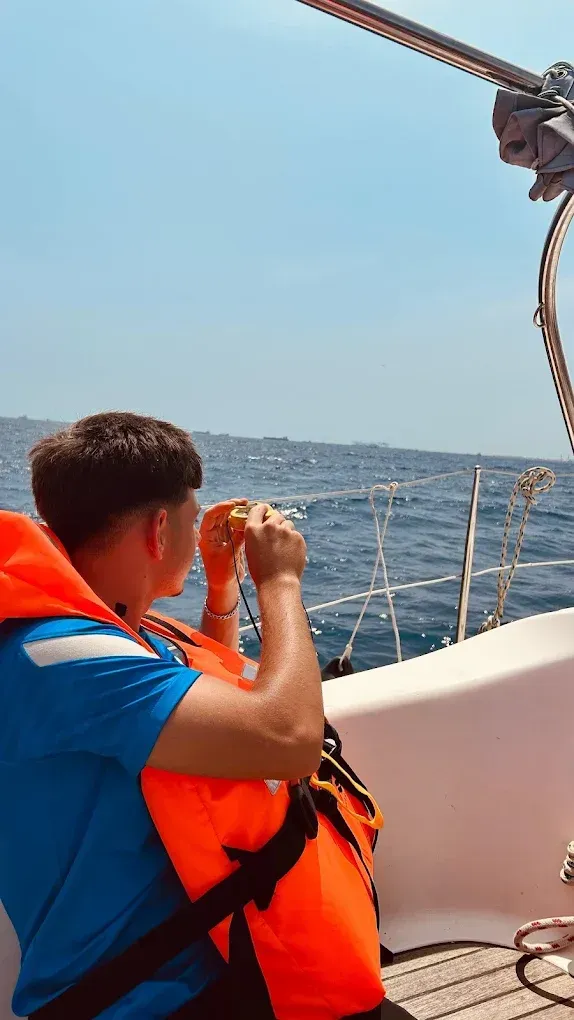
The sextant does not measure distances, it measures angles. To know where you are, you need to measure the altitude of a celestial body (Sun, Moon, stars) above the horizon.
The calculation process:
- Measure the sextant altitude (Hs) with the sextant.
- Correct the errors (refraction, semi-diameter) to get the true altitude (Ho).
- Look up the Nautical Almanac with the exact time (UT).
- Solve the spherical navigational triangle.
- Get a line of position. You are somewhere on that line.
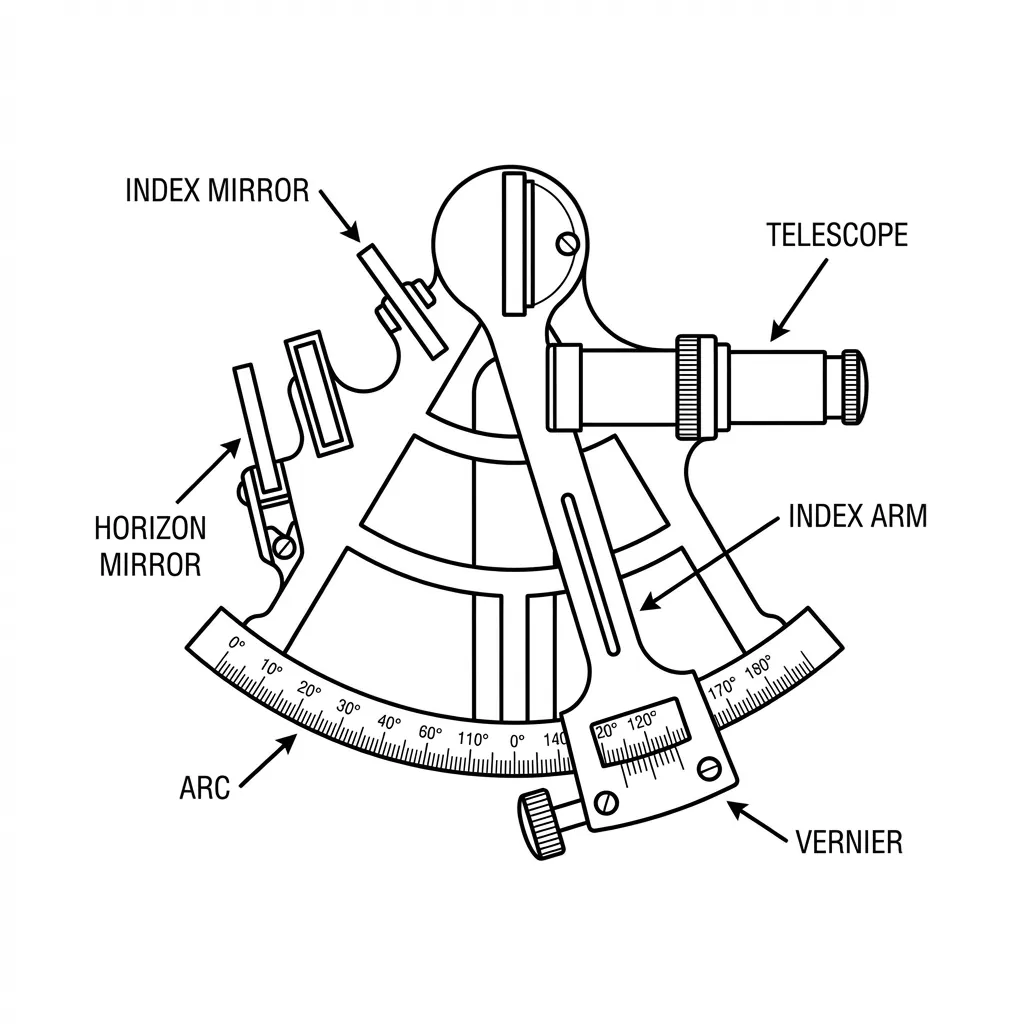
Anatomy of the sextant
The result is not a fixed point, it is a line of position. To fix your exact location (where the lines cross), you need to wait a few hours and take another sight (running fix) or measure two stars at the same time at twilight.
The longitude problem and Harrison’s clock
Working out latitude (north/south) was easy: all you had to do was measure the altitude of the Pole Star or of the Sun at noon. The great historical drama was longitude (east/west).
“Knowing where you are on the parallel is easy. Knowing where you are on the meridian is the problem that has killed thousands of sailors.”
The challenge of time
To find your longitude, you need to know the exact time at the reference meridian (Greenwich) and compare it with your local time (local noon). The time difference gives you the east/west distance.
The fatal error
A 1-minute error on the clock means an error of 15 nautical miles at the equator. Ships were lost and wrecked because pendulum clocks did not work with the motion of the sea.
The solution: H4
John Harrison, an English carpenter, invented the H4 marine chronometer in the 18th century, a mechanical clock able to keep accurate time at sea. It was the greatest technological revolution before GPS.
Boating is more than driving a boat
On our courses we don’t just teach you to pass the exam, we pass on the culture of the sea. If this world fascinates you, join Altair’s community of students.
No licence yet?
Get your Navigation Licence in a single day