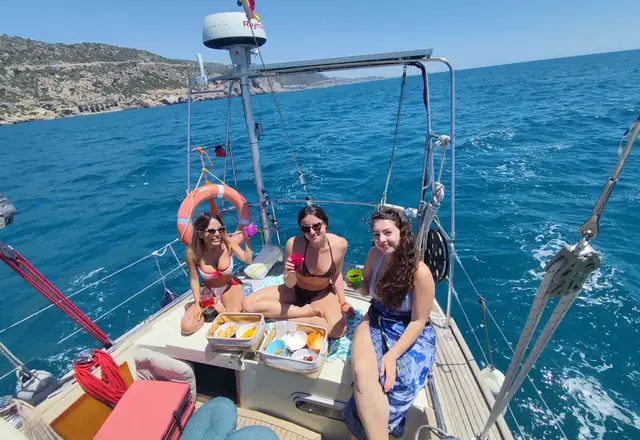

Ever noticed how your head empties the moment you cast off? It’s not just seafaring romance. Researchers have spent years trying to explain why water does us so much good, and what they’ve found fits pretty well with what we see on board every week.
“If there is magic on this planet, it is contained in water.” — Loren Eiseley, The Immense Journey (1957)
What is the blue mind?
The term was popularised by Wallace J. Nichols in his book Blue Mind (2014). Nichols gathers research from neuroscience and psychology to argue a simple idea: water takes us out of the everyday “alert” mode —notifications, rushing, noise— and into a calmer, more open and more creative state.
The opposite would be the “red mind”: constant stress, a nervous system always on guard. The blue mind isn’t magic; it’s what happens when our surroundings stop demanding that we react to everything.
What the studies say
The most solid research comes from the field of blue spaces (sea, rivers, lakes). The European BlueHealth project and Mathew White’s team at the University of Exeter have studied thousands of people in several countries. Their conclusions, summarised in a review published in Environmental Research (2020), are cautious but consistent:
- Living near the coast or visiting it often is associated with better general and mental health.
- Activities by the water tend to involve more physical activity and more company, two things that help in their own right.
- Landscapes with water are seen as more restorative: people say they feel more rested after spending time in them.
Another study by the same group, in Scientific Reports (2019), found that people who spend at least two hours a week in natural settings report better health and wellbeing than those who don’t.
It’s worth reading this carefully: these are associations, not cures. The sea is no substitute for a doctor or a psychologist. But it is one of the most enjoyable ways of doing something almost every study recommends: moving, getting outdoors and switching off for a while.
Why sailing is different
Looking at the sea from the promenade already does you good. Sailing goes a step further, because the boat asks you to take part.
Mindfulness without trying
At the helm you can’t think about your email. You have to watch the wind on the water, feel the boat heel, listen for the sail flapping. It’s what many people look for in meditation, but here it comes on its own: the sea makes you stay in the present.
A challenge that fits
Learning to trim, tack or dock gives a very particular satisfaction: doing something difficult and seeing it work. That sense of competence, of getting better outing after outing, is one of the most noticeable things in students who start out unsure of themselves.
No screens
On the water your phone fades into the background almost without you noticing. There’s too much to look at, and your hands are busy with the sheets.
Teamwork
A sailing boat takes several people to sail. Trimming a sheet while someone else steers, coordinating a docking manoeuvre, sharing lunch at anchor: a boat brings people together far more than you’d think.
What we see on board
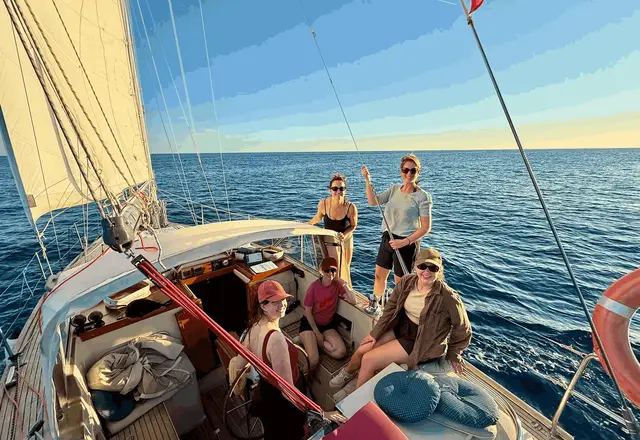
After more than 27 years teaching people to sail, one thing keeps happening: people step off the boat different from how they stepped on. They arrive with their heads at work and, back in port, they talk about the colour of the water, the dolphins they saw or the manoeuvre they finally nailed.
It isn’t a treatment and we don’t sell it as one. But it’s a good reason to get a licence or, simply, to spend an afternoon at sea.
Where to start
- If you just want to try it: a sunset sailing trip from Port Garraf, no sailing knowledge needed.
- If you want to skipper the boat yourself: the Navigation Licence, with no exam, or the PER, the full licence.
- If you want to live it fully: PER on Board, six days living aboard the sailing boat BELA with all the PER practical training.
- If you already have a licence and haven’t sailed since: the sailing club, where we let you know when a place becomes free on a real outing.
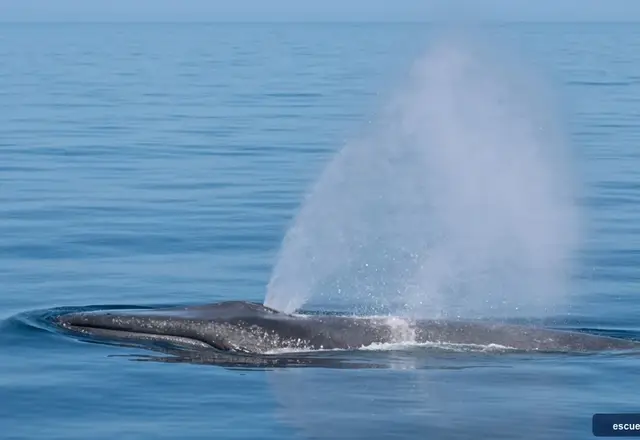
And if you’re interested in the scientific side of the sea off Port Garraf, there’s our guide to the wildlife of the submarine canyons.