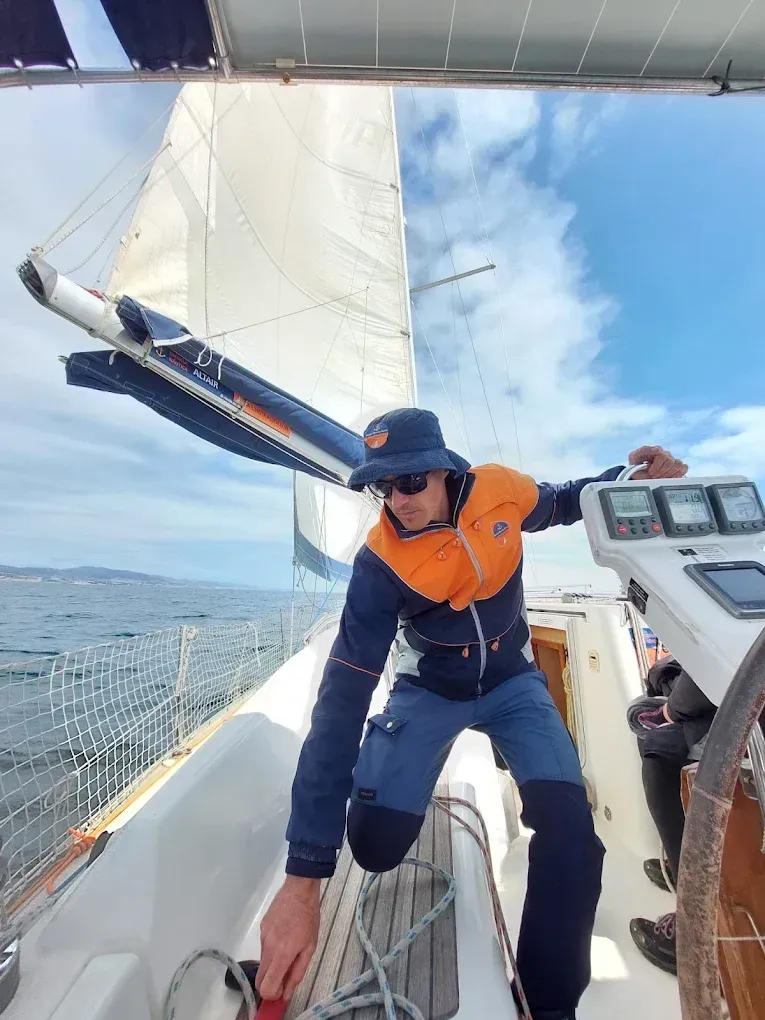
It’s every skipper’s nightmare: a crew member falls overboard! ⚠️ There’s no time for panic; there’s only a drill. But safety has moved on. The classic lifebuoy is only the beginning.
The danbuoy: gaining height so you don’t lose sight
A key piece of kit (widely used under British regulations and in ocean racing) is the danbuoy. It is a pole (telescopic or inflatable) that you throw into the water, where it floats upright, holding a flag and a strobe light more than 2 metres high.
Why is it vital? Because it lets the skipper see where the casualty is from a distance, even in waves that would hide a normal lifebuoy. Gaining sight means gaining time.
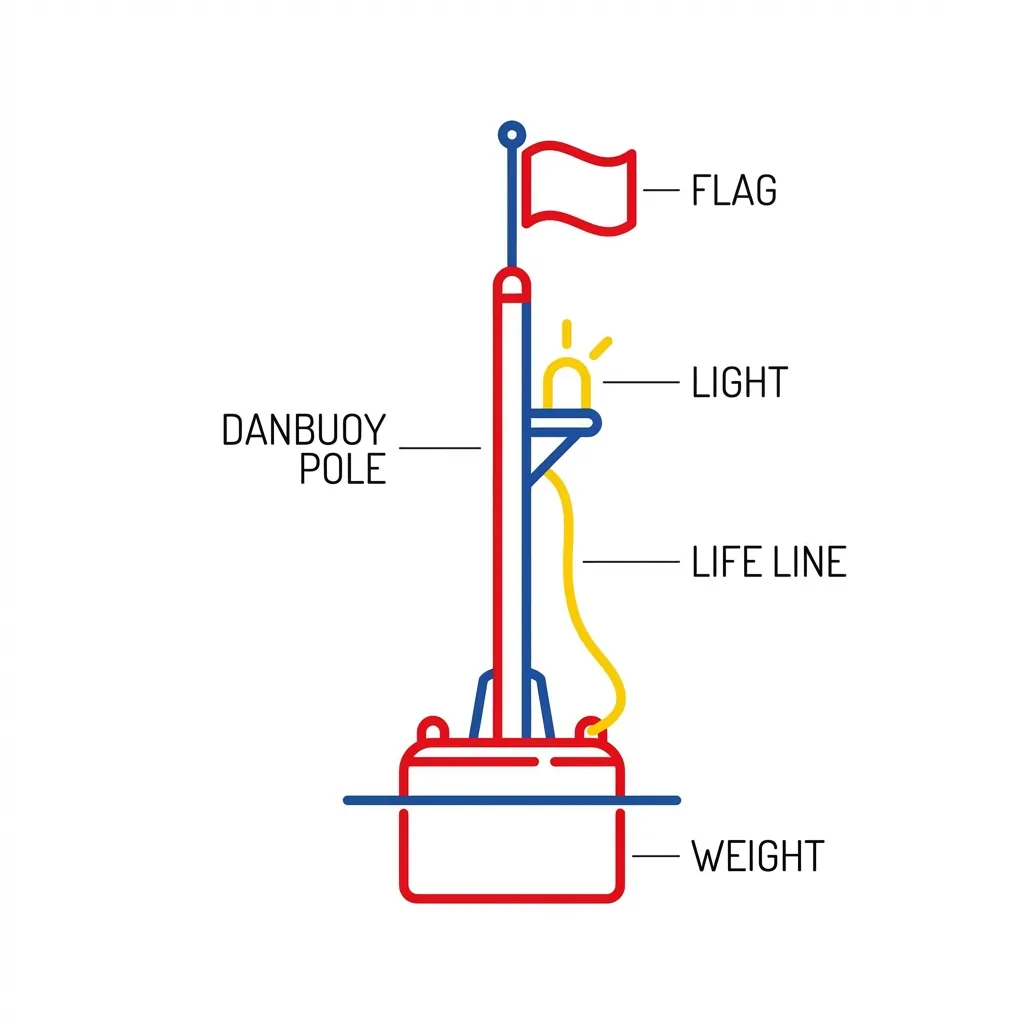
Danbuoy technical diagram
Technology that finds you: personal locator beacons (AIS MOB)
This is where boating has taken a giant leap. Forget searching “by eye”. These days we recommend all our students fit their lifejackets with personal AIS MOB devices.
How do they work? It is a small device that sits inside the auto-inflating lifejacket. When you hit the water and the lifejacket inflates, the device switches on automatically and sends out an alert signal.
Real-time result
On your GPS/chartplotter screen (and on those of all nearby boats), a red circle with a cross appears instantly, marking the exact position and drift of the person in the water.
The advantage: it removes the “panic” of losing visual contact. The GPS tells you exactly where to steer to make the recovery.
“One hand for you, one for the boat”: prevention
We talk a lot about recovering the person in the water, but the best man-overboard manoeuvre is the one that never happens. On our PER and PNB courses we go on (proudly) about using the harness and the jackstay.
There’s no point having the best electronics if we don’t respect the basic rules of seamanship.
🚨 Would you know how to react if this happened tomorrow?
Reading about it in a blog is fine, but practising it on board is what gives you confidence. In Escuela Náutica Altair’s Safety and Navigation practical sessions we run real drills.
Don’t get your licence just “for the paper”. Get it to learn.
Quick summary for the exam (and for real life):
- 1 Shout and never take your eyes off them.
- 2 Throw the lifebuoy/danbuoy and press MOB on the GPS.
- 3 If they have a personal AIS, confirm the signal on the chartplotter.
- 4 Make the approach (Anderson or Boutakow turn) and always pick them up on the leeward side (sheltered from the wind by the boat itself).