At sea, clear communication can save lives. The International Code of Signals (INTERCO in Spanish) is the worldwide standard sailors use to spell names, positions or critical messages over the radio (VHF), and to communicate visually with flags.
In this article you will find two essential tools to pass your PER or PNB exam and for life on board.
The phonetic alphabet: a memory trick
Under pressure it can be hard to remember names like “Quebec” or “Whiskey”. This illustration helps you memorise each letter by linking it to a fun image:
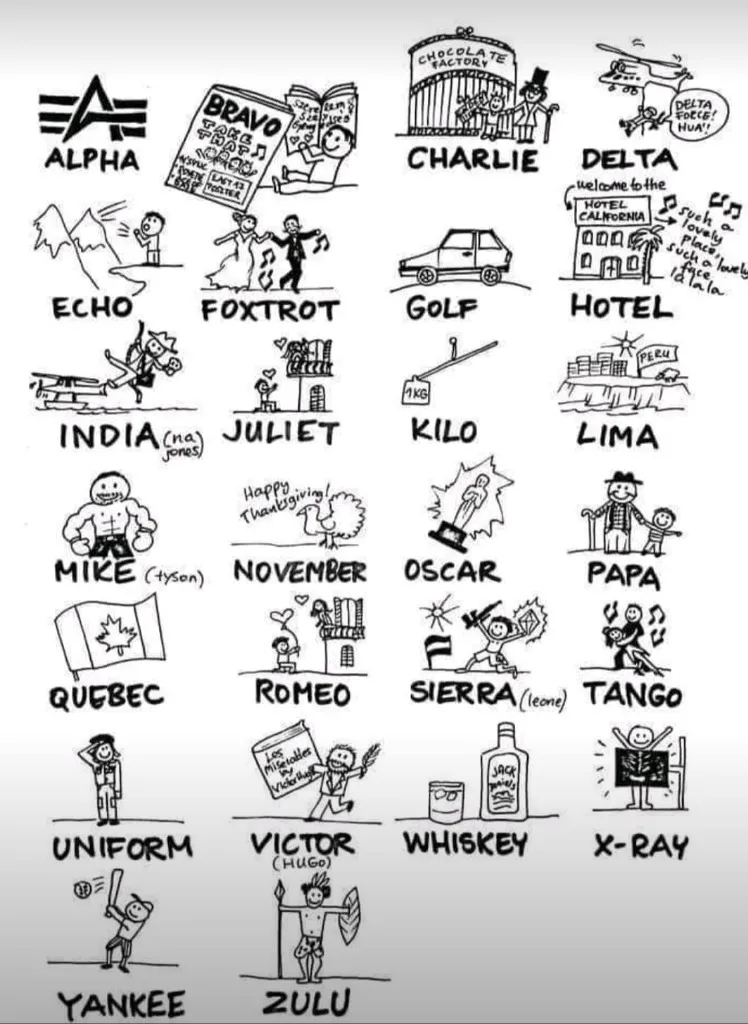
Link each letter to a visual idea so you never forget it.
Flag meanings and pronunciation
Each letter is not only for spelling: when a single flag is hoisted, it has a specific meaning. Here is the full list based on the official code:
| Letter | Name | Pronunciation | Meaning (single flag) |
|---|---|---|---|
| A | Alfa | AL FA | I have a diver down; keep well clear at slow speed. |
| B | Bravo | BRA VO | I am taking in, discharging or carrying dangerous goods. |
| C | Charlie | CHAA LI | Yes (affirmative). |
| D | Delta | DEL TA | Keep clear of me; I am manoeuvring with difficulty. |
| E | Echo | E CO | I am altering my course to starboard. |
| F | Foxtrot | FOX TROT | I am disabled; communicate with me. |
| G | Golf | GOLF | I require a pilot (or, by fishing vessels: I am hauling nets). |
| H | Hotel | HO TEL | I have a pilot on board. |
| I | India | IN DIA | I am altering my course to port. |
| J | Juliet | YU LI ET | I am on fire and have dangerous cargo on board: keep well clear of me. |
| K | Kilo | KI LO | I wish to communicate with you. |
| L | Lima | LI MA | You should stop your vessel instantly. |
| M | Mike | MA IK | My vessel is stopped and making no way through the water. |
| N | November | NO VEM BER | No (negative). |
| O | Oscar | OS CAR | Man overboard! |
| P | Papa | PA PA | In harbour: all persons should report on board as the vessel is about to sail. |
| Q | Quebec | QUE BEK | My vessel is healthy and I request free pratique. |
| R | Romeo | RO ME O | Received / Understood. |
| S | Sierra | SI E RRA | I am operating astern propulsion. |
| T | Tango | TAN GO | Keep clear of me; I am engaged in pair trawling. |
| U | Uniform | IU NI FORM | You are running into danger. |
| V | Victor | VIC TOR | I require assistance. |
| W | Whiskey | UIS KI | I require medical assistance. |
| X | X-ray | EKS REY | Stop carrying out your intentions and watch for my signals. |
| Y | Yankee | IAN KI | I am dragging my anchor. |
| Z | Zulu | ZU LU | I require a tug. |
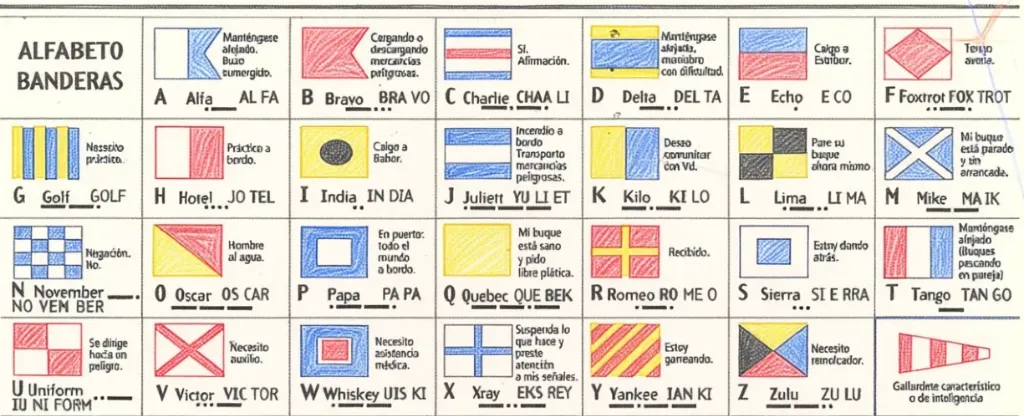
Reference table: flags, alphabet, substitutes and numbers.
Numbers in the International Code
Even numbers have their own way of being pronounced, to avoid confusion with radio static:
Why does it matter?
During a radio call, especially in an emergency, spelling your position or your boat’s name with the phonetic alphabet makes sure the receiver (Spanish Maritime Rescue or other vessels) understands exactly what you say, with no mistakes from similar sounds or poor reception.
Preparing for the theory exam?
Our virtual classroom has specific tests on rules and signals (in Spanish). See the PER course